

Implant-supported dentures refer to medically fitted prostheses that are attached to artificial titanium tooth roots in the jawbone, providing a stable and aesthetically pleasing replacement for missing teeth. This type of treatment is particularly relevant for patients over 40 in Berlin because it permanently restores chewing function and protects the bone from further loss. The options range from removable bar-retained dentures to fixed systems like All-on-4 or single implants. Which option is right for you depends on bone structure, overall health, and budget. This article explains all the options clearly and specifically, so you can go into your consultation well-informed.
The table shows that those who need a single implant pay significantly less at CASA DENTALIS than the Berlin market average, as our prices are around 20 to 30 percent below the usual level.
 Whether you’re considering a single implant, a bridge prosthesis, or the All-on-4 system, at CASA DENTALIS you’ll receive an honest assessment of the best treatment option for your individual situation. We work with Nobel Biocare implants and our prices are significantly below the Berlin market average. If you already have a quote from another dentist, let us compare it. Schedule an appointment by calling 030 53 14 19 10 or booking directly online. For more information on costs and the treatment process, please visit our page on dental implant costs and options . For a comprehensive overview of requirements and risks, we recommend our page on implant requirements and procedures .
What types of dental implants are available?
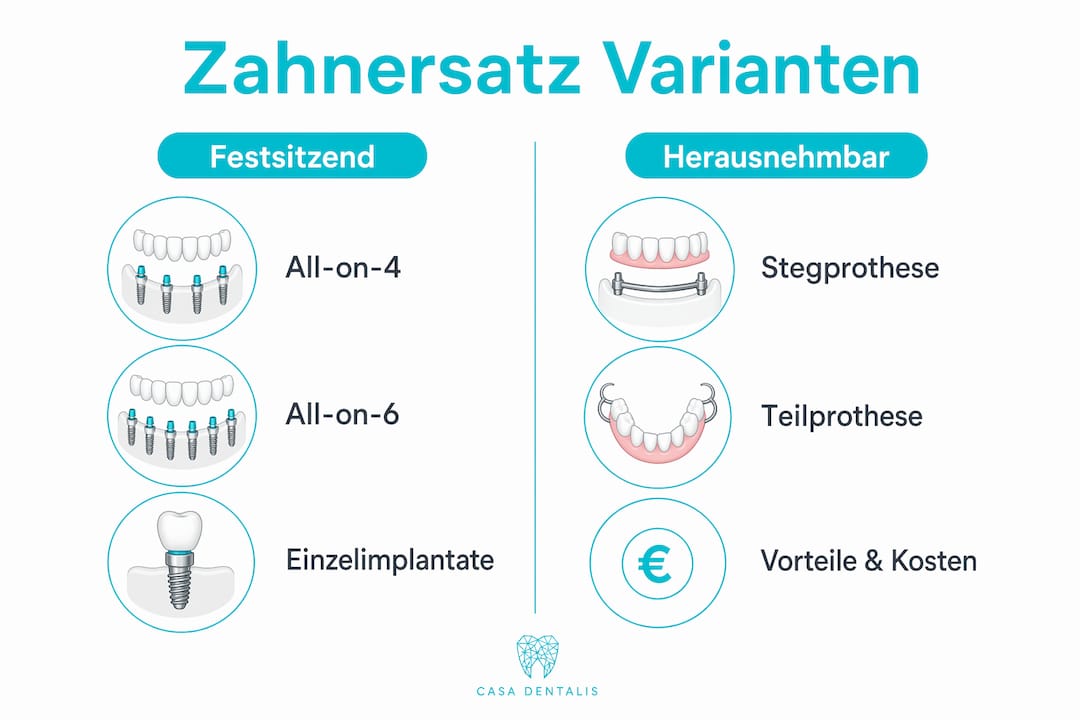
Implant-supported dentures can be divided into two main groups: fixed and removable. Both groups offer different advantages and disadvantages, which depend directly on your anatomical conditions and your daily life.
Removable bar prosthesis
A bar-retained denture is anchored to two to four implants and is the most affordable implant-supported solution. A metal bar connects the implants, the denture snaps onto it, and can be removed for cleaning. According to specialist information, a bar-retained denture on implants offers 60 to 70 percent of the chewing strength of natural teeth, with a lifespan of 10 to 15 years. This means you get significantly more stability than with a conventional denture, without the expense of a fully fixed prosthesis.Fixed concepts: All-on-4, All-on-6 and single implants
All-on-4 refers to a treatment where a complete set of teeth is attached to four strategically placed implants. All-on-6 works on the same principle but offers greater stability through two additional implants and is particularly suitable for the upper jaw. Single implants selectively replace one or more missing teeth without putting stress on adjacent teeth. At CASA DENTALIS, we work with Nobel Biocare, one of the world’s leading manufacturers of premium implants, ensuring durability and precision. Pro tip: Always ask about the implant system used during your consultation. Brand-name implants from Nobel Biocare or Straumann have significantly better long-term documentation than generic products.
Comparison of the most important variants
| variant | Costs (approx.) | stability | Care |
|---|---|---|---|
| Bar prosthesis (2 implants/jaw) | from 6,750 euros/pine | Medium (60–70% chewing strength) | Removable, easy to clean |
| All-on-4 (one jaw) | from 12,000 euros | High, firmly attached | Thorough cleaning with an interdental brush |
| All-on-4 (both jaws) | approximately 30,000 euros | Very high | Thorough cleaning, aftercare required |
| Single implant with crown | 800 to 1,600 euros | Very high | Like a natural tooth |
Which anatomical factors influence the choice?
The condition of the jawbone is the decisive medical factor in selecting the appropriate treatment. Not every patient comes to the practice with the same conditions. The most important influencing factors at a glance:- Bone volume in the lower jaw: Usually sufficient for standard implants, as the lower jaw is denser and more stable.
- Bone quality in the upper jaw: Often lower than in the lower jaw. A sinus lift or bone graft may be necessary and costs an additional 1,000 to 2,000 euros.
- Mini implants for bone deficiency: If the bone volume is insufficient for standard implants, mini implants are an alternative . They are more cost-effective, often allow immediate loading, but are not suitable for every case.
- General health: Uncontrolled diabetes, active periodontitis or bisphosphonate therapy may be contraindications and must be clarified before treatment.
- Oral hygiene: Those with motor limitations or difficulties cleaning fixed prostheses benefit from removable restorations. Removable dentures are often easier to clean and can prevent inflammation around the implant.
How much does it cost to have dental implants in Berlin?
Cost transparency is particularly important for patients over 40, as the decision to get implants often represents a long-term investment. At CASA DENTALIS, we talk openly about the numbers.Cost framework of the most important services
Ein Einzelzahnimplantat mit Aufbau und Krone kostet bei CASA DENTALIS je nach Zahnposition zwischen 800 und 1.600 Euro. Zum Vergleich: Der Berliner Marktdurchschnitt liegt für vergleichbare Versorgungen bei 1.500 bis 2.500 Euro pro Implantat. Eine Stegprothese auf zwei Implantaten pro Kiefer kostet rund 13.500 Euro, eine All-on-4-Versorgung für beide Kiefer liegt bei etwa 30.000 Euro. Das sind erhebliche Investitionen, die sich aber über viele Jahre amortisieren, wenn die Versorgung gut geplant und gepflegt wird.Was zahlt die Krankenkasse?
Die gesetzliche Krankenversicherung zahlt bei implantatgetragenem Zahnersatz nur einen sehr begrenzten Festzuschuss von etwa 257 bis 358 Euro pro Kiefer bei zahnlosem Kiefer. Das bedeutet: Der Großteil der Kosten bleibt als Eigenanteil. Bei einem Einzelimplantat mit Gesamtkosten von rund 4.000 Euro verbleiben über 3.000 Euro Eigenanteil bei gesetzlich Versicherten. Wer eine private Zahnzusatzversicherung abgeschlossen hat, kann je nach Tarif 50 bis 80 Prozent der Implantatkosten erstattet bekommen. Praktische Tipps zur Kostenoptimierung:- Bonusheft führen: Regelmäßige Zahnarztbesuche über mindestens fünf Jahre erhöhen den GKV-Festzuschuss um bis zu 30 Prozent.
- Zahnzusatzversicherung früh abschließen: Vor der Diagnose eines Zahnverlusts, da Versicherungen Vorerkrankungen ausschließen können.
- Heil- und Kostenplan einholen: Lassen Sie sich einen HKP ausstellen und vergleichen Sie. Wenn Sie bereits ein Angebot von einem anderen Zahnarzt haben, kommen Sie zu CASA DENTALIS. Wir machen Ihnen ein besseres Angebot.
- Planungskosten einkalkulieren: DVT, Bohrschablonen und 3D-Planung machen bei komplexen Versorgungen 5 bis 15 Prozent der Gesamtkosten aus und werden oft unterschätzt.
Wie läuft die Behandlung von Zahnersatz auf Implantaten ab?
Der Behandlungsablauf folgt einem klaren Schema, das Patienten Sicherheit gibt. Unsicherheit entsteht oft, weil der Prozess mehrere Monate dauert und mehrere Schritte umfasst.- Erstberatung und Diagnostik: Klinische Untersuchung, DVT-Aufnahme und Besprechung Ihrer Wünsche und Voraussetzungen. Bei CASA DENTALIS ist diese Beratung kostenlos.
- Backward-Planning: Der Zahnersatz bestimmt die Implantatposition, nicht umgekehrt. Dieses Planungsprinzip verhindert Fehlplatzierungen und sichert optimale Funktion und Ästhetik.
- Implantatinsertion: Das Implantat wird unter lokaler Betäubung oder auf Wunsch unter Sedierung gesetzt. Angstpatienten können bei CASA DENTALIS die gesamte Behandlung in Dämmerschlaf erleben.
- Einheilphase: Im Unterkiefer dauert die Osseointegration, also das Einwachsen des Implantats in den Knochen, etwa 6 bis 8 Wochen. Im Oberkiefer sind es 3 bis 6 Monate. Bei ausreichender Primärstabilität ist Sofortbelastung möglich, was die Behandlungszeit deutlich verkürzt.
- Implantat-Freilegung: Nach der Einheilphase wird das Implantat freigelegt und ein Aufbau eingesetzt.
- Zahnersatz-Einsetzen: Der individuelle Zahnersatz wird eingegliedert und angepasst.
- Nachsorge: Regelmäßige Kontrollen und professionelle Reinigung sichern die Langlebigkeit der Versorgung.
Welche Alternativen zu Implantaten gibt es?
Implantate sind nicht für jeden Patienten die einzige Option. Wer aus gesundheitlichen oder finanziellen Gründen keine Implantate möchte, hat weitere Möglichkeiten. Die wichtigsten Alternativen im Überblick:- Zahnbrücke: Ersetzt einen oder mehrere fehlende Zähne, indem Nachbarzähne als Pfeiler beschliffen werden. Kostengünstiger als Implantate, aber die Beschleifung gesunder Zähne ist ein dauerhafter Eingriff. Ein direkter Vergleich von Brücke und Implantat zeigt, wann welche Lösung sinnvoller ist.
- Teleskopprothese: Eine herausnehmbare Prothese, die auf Teleskopkronen über eigenen Restzähnen oder Implantaten sitzt. Sehr stabil, ästhetisch ansprechend und gut reinigbar.
- Klammerprothese: Die kostengünstigste herausnehmbare Variante, die mit Metallklammern an Restzähnen befestigt wird. Funktional, aber ästhetisch eingeschränkt.
- Miniimplantate: Bei stark reduziertem Knochenangebot sind Miniimplantate als Spezialfall eine wertvolle Alternative, sollten aber nicht als Standardersatz für reguläre Implantate gewählt werden.
Wichtigste Erkenntnisse
Implantatgetragener Zahnersatz bietet Patienten ab 40 in Berlin die dauerhafteste und funktionell überzeugendste Lösung für fehlende Zähne, wobei die Wahl zwischen festsitzend und herausnehmbar von Knochen, Gesundheit und Budget abhängt.| Punkt | Details |
|---|---|
| Variantenauswahl | Stegprothese, All-on-4, All-on-6 und Einzelimplantate decken unterschiedliche Bedürfnisse und Budgets ab. |
| Kosten bei CASA DENTALIS | Single implants from 800 euros, 20 to 30 percent below the Berlin market average with Nobel Biocare quality. |
| Statutory health insurance reimbursement | The statutory fixed subsidy covers only a small portion of the implant costs. Supplemental dental insurance is advisable. |
| Backward planning | The planned dental prosthesis determines the number and position of the implants, not the other way around. |
| Act early | Bone loss after tooth loss worsens the initial situation and increases treatment costs. |
My assessment as a dentist in Berlin
Written by Dr. Herbst, dentist and co-founder of CASA DENTALIS. What continues to surprise me after many years in implantology is that most patients come too late. Not because they don’t want to, but because they wait until their suffering becomes unbearable. And that’s precisely the most expensive mistake. Progressive bone loss after tooth loss makes subsequent restorations more complex and costly. Those who come early have more options and pay less. Another misconception I encounter regularly is that many patients believe fixed dentures are automatically better. This isn’t true. For some patients, especially those with difficult oral hygiene or limited bone volume, a well-fitting bar-retained prosthesis is the wiser and more stable long-term option. The decision must be made on an individual basis, not according to trends or advertising. What I always tell my patients in Lichterfelde, Steglitz, and Zehlendorf is: Come for a consultation before you’ve made a decision. Bring your current quote with you. Together, we’ll look at what truly suits your situation, and we’ll discuss costs openly. That’s the approach I would have wanted myself as a patient.— Dr. Herbst, dentist and co-founder of CASA DENTALIS
Planning your implant-supported dental prosthesis at CASA DENTALIS
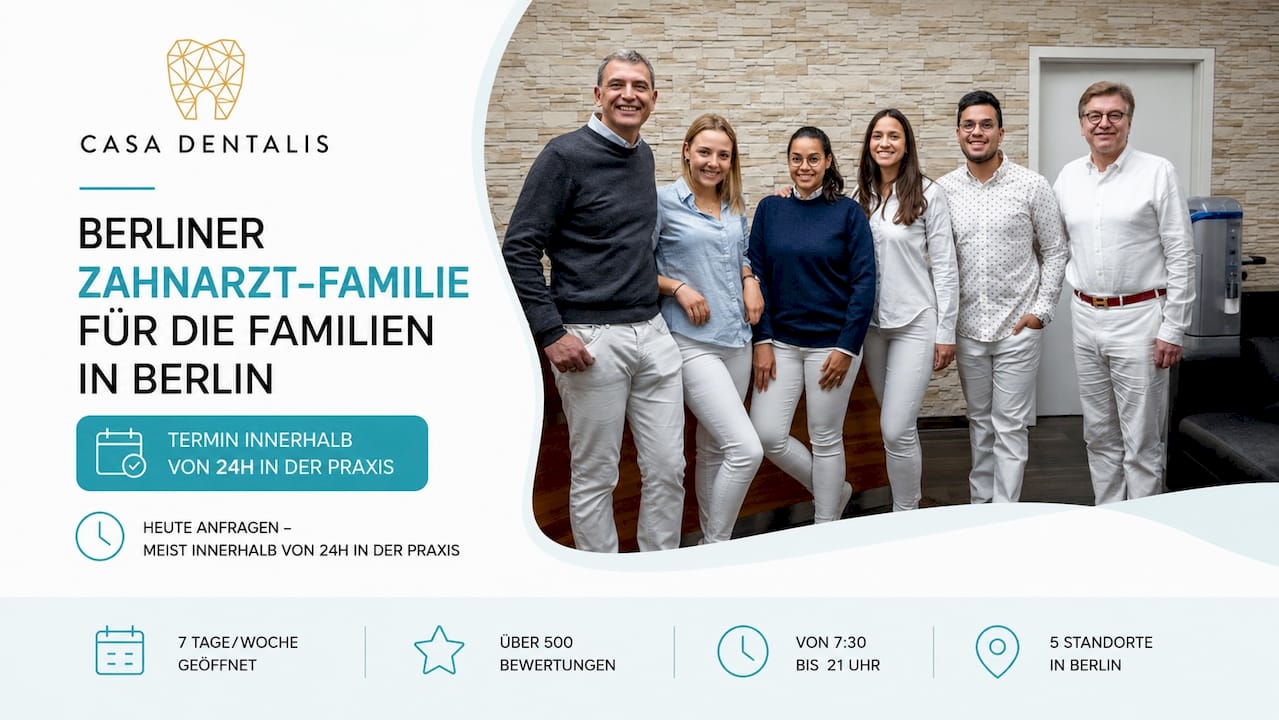
CASA DENTALIS advises patients in southern and western Berlin at five locations, including Lichterfelde (Drakestraße 23a), Steglitz, and Zehlendorf. The practice is open from 7:30 a.m. to 9:00 p.m., 7 days a week, 364 days a year. Anyone with questions about costs, procedures, or treatment options will receive a personalized treatment and cost plan from CASA DENTALIS, with no hidden fees.
Whether you’re considering a single implant, a bridge prosthesis, or the All-on-4 system, at CASA DENTALIS you’ll receive an honest assessment of the best treatment option for your individual situation. We work with Nobel Biocare implants and our prices are significantly below the Berlin market average. If you already have a quote from another dentist, let us compare it. Schedule an appointment by calling 030 53 14 19 10 or booking directly online. For more information on costs and the treatment process, please visit our page on dental implant costs and options . For a comprehensive overview of requirements and risks, we recommend our page on implant requirements and procedures .